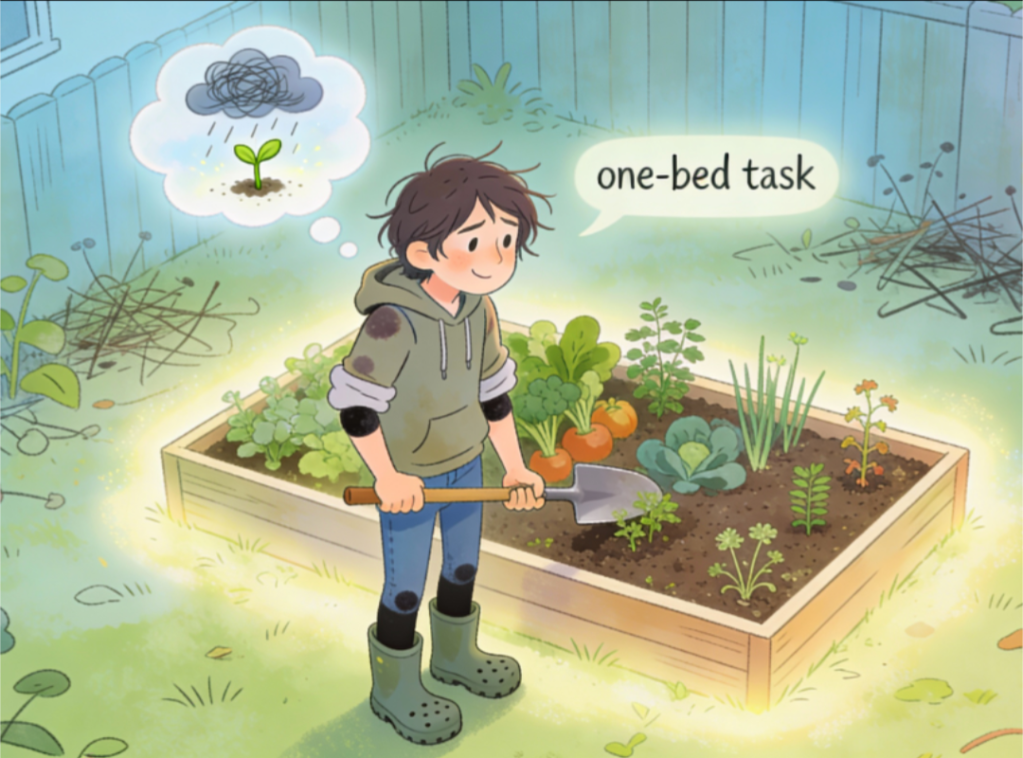
There are days when your brain feels like over watered soil, heavy, soggy, and not taking in anything new. On those days, “self-care” advice feels ridiculous! I don’t want a bubble bath. I want my thoughts to slow down enough that I can hear myself think! Gardening is the only thing that reliably does that for me, and there is science backing that up. Studies show that gardening activities can reduce anxiety, depression, and stress, and improve overall well-being and life satisfaction.
When I talk about “gardening for mental health,” I don’t mean designing some Pinterest-perfect landscape. I mean walking outside in your stretched-out sweatshirt, looking at one raised bed, and deciding, “Okay, I can do this tiny thing.” Research on therapeutic gardening and horticultural therapy shows that even small, structured tasks, like watering, weeding a section, or tending a single container, can improve mood, focus, and emotional regulation.
On my worst brain-fog days, I use what I call “one-bed task days.” The rule is simple: I pick one bed or one container and give it 10–20 minutes. That is all. Evidence from mental health studies suggests that focusing on one concrete task in a natural setting can reduce racing thoughts, support attention, and boost a sense of control.
I am not trying to fix my whole yard or my whole life. I am just trying to do one true thing with my hands.
Here is what that looks like in real life. I step outside, probably still annoyed at my email inbox. I walk to the messiest bed I can emotionally tolerate. Then I choose one job only: pull the big weeds, or top up mulch, or deadhead the flowers. Research indicates that gardening can work like a moving meditation, where repetitive actions combined with sensory input, smell of soil, feel of leaves, sound of birds, quiet the nervous system and lower stress hormones.
I notice the color of the leaves. I listen for that one bossy bird. I let my brain shrink down to what is right in front of me.
The first five minutes are the hardest, because my mind still wants to replay the argument, the to-do list, the worry about money or work. Then something shifts once my hands are busy. Studies have found that people who garden regularly report better mood, higher self-esteem, and a stronger sense of purpose, even in vulnerable groups like seniors or people with chronic mental health challenges.
That “sense of purpose” doesn’t have to be grand. It can be as small as, “These tomatoes are alive because I showed up.”
There is also a quiet kind of resilience you build without noticing. Plants die. Weather wrecks your plans. Pests show up uninvited. Evidence from horticultural therapy research notes that learning to respond to setbacks in the garden, adjusting, replanting, trying again, can strengthen coping skills and psychological resilience over time.
When you practice not quitting on your garden after a bad hailstorm, you are secretly practicing not quitting on yourself after a bad week.
If you are brand new to gardening or you only have a tiny space, the mental health benefits are still there. Studies on small-space and urban gardening, including rooftop and community gardens, show improvements in emotional well-being, social connection, and quality of life.
A couple of pots on a balcony, a grow bag by the back step, or a single raised bed can absolutely be enough “green” for your nervous system to respond.
So, how do you turn this into something you can actually use on your worst days? Here is a simple Yard 2 Yield mini-plan you can steal:
Make a “bad brain list” of 3–5 tiny garden tasks that take 10–20 minutes (examples: weed the front half of one bed, water all containers, harvest anything ripe, prune one plant, top up mulch in one spot). Research suggests that having low-pressure, meaningful activities ready to go makes it easier to start when you are low on motivation.
Pick a physical cue to start. For some people it is putting on garden shoes; for others it is filling the watering can. Studies show that pairing a small ritual with a healthy habit increases the odds you will follow through.
While you work, deliberately notice three sensory details: what you see, hear, and feel. This kind of grounded attention overlaps with mindfulness techniques that are known to reduce anxiety and improve mood.
Stop when the timer goes off. The goal is not exhaustion; it is a small, successful reset. Research on therapeutic gardening emphasizes that consistent, manageable engagement delivers mental health benefits over time.
On paper, it looks too simple: go outside, touch plants, feel better. But the combination of movement, fresh air, focused attention, and tiny wins in the garden is a powerful cocktail for a tired brain, and there is growing clinical evidence to back that up.
When life feels like too much, your yard does not have to be one more thing on the list. It can be the one place where you are allowed to do less, move slower, and still grow something worth keeping!
 Yard 2 Yield!